Luke Howard Defends His PhD Thesis
Congratulations to Lucas (Luke) Howard on defending his PhD dissertation today!
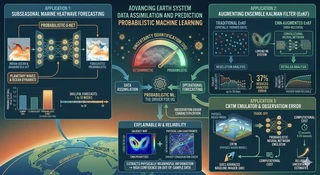
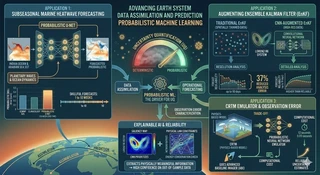
Title: Advancing Earth System Data Assimilation and Prediction with Probabilistic Machine Learning
Date: Monday, April 6, 2026, 10:00 AM MT
Location: SEEC N128
Abstract
Probabilistic machine learning methods offer significant potential for advancing earth system prediction, but existing applications have largely been deterministic, limiting their utility in contexts where uncertainty quantification is essential. This dissertation advances probabilistic machine learning for earth system prediction across three distinct but complementary applications, each targeting a persistent bottleneck in operational forecasting or data assimilation.
In the first application, a probabilistic U-Net-based neural network is developed for subseasonal marine heatwave forecasting in the northern Indian Ocean and Arabian Sea. The model produces skillful probabilistic forecasts at lead times of up to 10 weeks, outperforming persistence and climatology benchmarks across a range of deterministic and probabilistic skill metrics and performing comparably to or better than the ECMWF S2S dynamical forecast. The results suggest that planetary waves and low-frequency ocean dynamics provide windows of predictability that a probabilistic machine learning approach can exploit.
In the second application, a convolutional neural network is used to augment an ensemble Kalman filter for the assimilation of high-resolution observations that would otherwise be discarded due to computational constraints. Demonstrated as a proof-of-concept on the Lorenz-96 system, the augmented method reduces analysis error by 37% compared to an ensemble Kalman filter operating on spatially thinned observations alone, and produces more accurate and reliable ensemble forecasts at lead times of up to 10 days.
In the third application, a probabilistic neural network emulator of the Community Radiative Transfer Model is developed for the GOES Advanced Baseline Imager. The emulator matches the accuracy of the full physics-based model at a fraction of the computational cost, while generating reliable uncertainty estimates that could improve observation error characterization in data assimilation systems. Explainable AI methods applied across the second and third applications confirm that the trained networks extract physically meaningful information, increasing confidence in their reliability on out-of-sample data.
We are proud of Luke’s contributions to the group and wish him all the best in his next chapter!
